


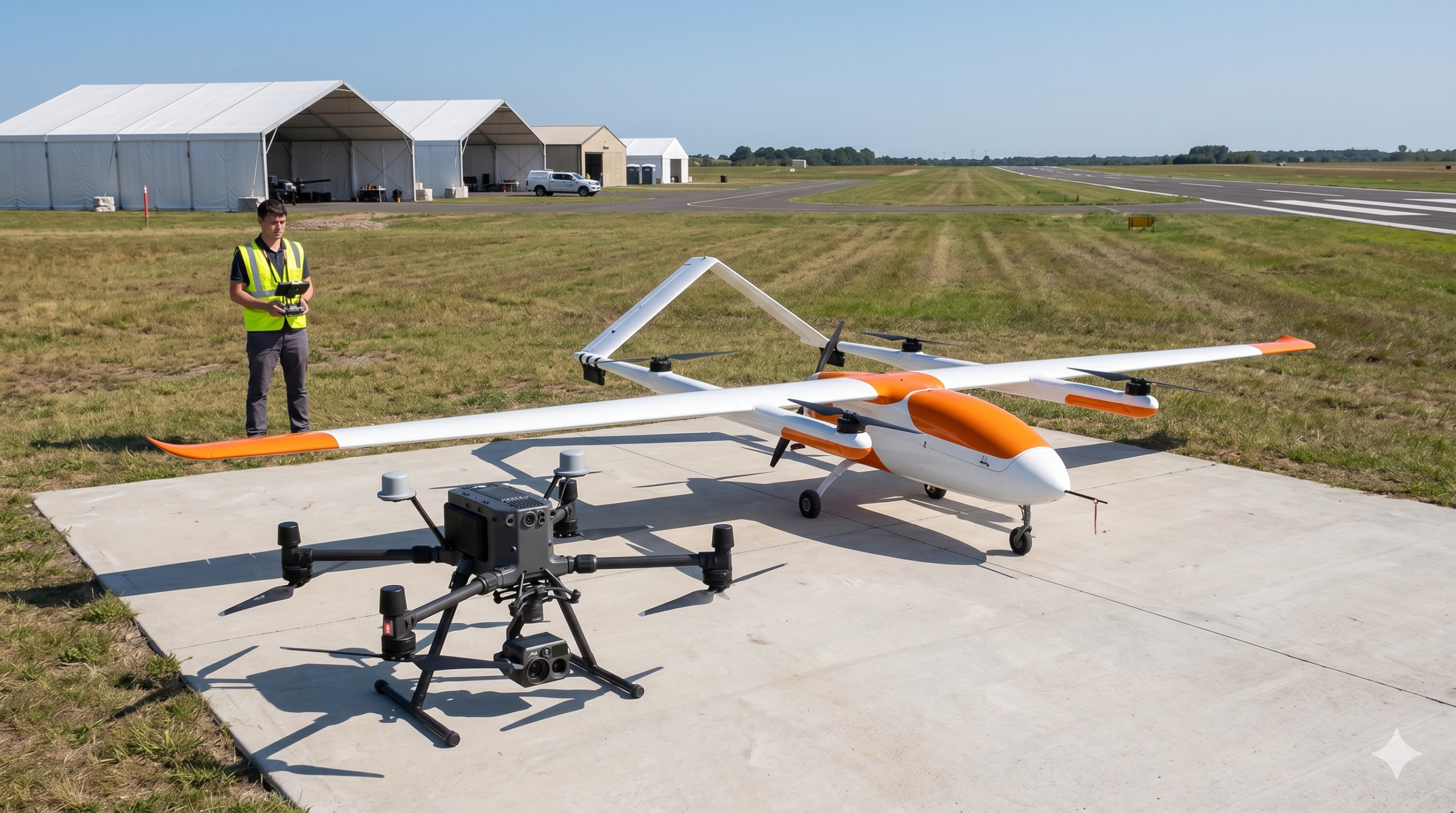
Drones, or unmanned aerial vehicles (UAVs), actively transform modern industries by offering practical solutions for aerial photography, surveying, agriculture, delivery, and surveillance. Among the most popular types, multi-rotor and fixed-wing drones currently lead the market. Crucially, each design brings distinct advantages and suits specific applications. Consequently, this document delivers an in-depth comparison of the benefits of multi-rotor drones versus fixed-wing drones, using real-world examples to illustrate key points.
Overview of Multi-Rotor and Fixed-Wing Drones
Multi-rotor drones use multiple propellers (typically 4, 6, or 8) to generate lift and thrust. As a result, this configuration allows for vertical takeoff and landing (VTOL), stable hovering, and agile manoeuvring. These drones are ideal for use in the construction industry. In particular, the quadcopter (four rotors) remains the most common industry setup.
In contrast, fixed-wing drones resemble traditional airplanes, relying on wings for lift and one or more propellers for thrust. While these drones traditionally require a runway or catapult for launch and cannot hover, they fly with extreme efficiency during forward flight. Furthermore, modern versions sometimes incorporate VTOL capabilities, thereby reducing the need for large takeoff and landing areas.
Benefits of Multi-Rotor Drones
1. Vertical Takeoff and Landing (VTOL)
First and foremost, multi-rotor drones take off and land vertically, requiring minimal operational space. This capability makes the drones ideal for flying in construction sites, urban environments, confined areas, or uneven terrain where runways are unavailable.
- Example: For instance, the DJI Mavic series of quadcopters launches easily from a small patch of grass, a rooftop, or even the back of a moving vehicle.
2. Hovering Capability
Another standout feature is the ability to hover in place with great stability. This feature enables precise positioning, which in turn makes them perfect for applications requiring stationary flight.
- Example: Specifically, the DJI Mavic 3 excels in aerial photography and videography by holding altitude and position for long-exposure shots or detailed structural inspections.
3. Agility and Maneuverability
In addition to hovering, multi-rotors move rapidly in any direction—up, down, forward, backward, and laterally—responding instantly to pilot inputs. This agility proves invaluable when navigating complex environments, flying indoors, or tracking moving subjects.
- Example: To illustrate, the Parrot Anafi flies effortlessly through dense forests to monitor wildlife or inspect hard-to-reach infrastructure.
4. Ease of Use
Furthermore, multi-rotor drones offer a highly user-friendly experience for beginners. Not only are their flight controls intuitive, but advanced flight controllers with GPS stabilisation also handle automated takeoff, landing, and waypoint navigation.
5. Compactness and Portability
Moreover, many multi-rotor drones feature lightweight, foldable designs that simplify transport. This portability of the drones is vital for flying in construction sites, spontaneous field operations, travel, and rapid deployment in emergency scenarios.
- Example: Take, for example, the DJI Mini 4 Pro, which weighs less than 250 grams and fits into a small bag, making it a favorite for travel bloggers and journalists.
6. Versatility in Payloads and Applications
Finally, multi-rotor drones carry a wide variety of cameras and sensors, including thermal imaging, LiDAR, and multispectral cameras. Because of their hovering capability, they perfectly support tasks like engineering inspection, site mapping, and public safety.
- Example: Accordingly, operators can equip the DJI Matrice 300 RTK with multiple payloads simultaneously to tackle search and rescue, firefighting, and infrastructure inspection.
Benefits of Fixed-Wing Drones

1. Longer Flight Times and Greater Range
On the other hand, fixed-wing drones maximize energy efficiency during forward flight, delivering significantly longer flight durations and greater coverage distances than multi-rotors. This is because the wings generate aerodynamic lift, subsequently requiring less battery power to stay aloft.
- Example: For example, the senseFly eBee X flies for up to 90 minutes on a single battery and covers hundreds of hectares per mission, thereby leading the industry in large-scale agricultural surveys.
2. Higher Speeds
In tandem with range, fixed-wing drones achieve much higher velocities. This speed accelerates tasks that require rapid area coverage, such as mapping, coastal surveillance, or disaster assessment.
- Example: In fact, the Quantum Systems Trinity F90+ flies at speeds up to 90 km/h, thus mapping extensive areas in record time.
3. Greater Payload Capacity
Due to their larger size and efficient aerodynamics, fixed-wing drones frequently carry heavier or more specialized payloads over long distances.
- Example: As a practical example, the Delair UX11 accommodates high-resolution sensors to optimize precision agriculture and industrial mapping.
4. Endurance in Challenging Weather
Additionally, fixed-wing designs provide superior stability in wind and turbulent conditions, maintaining course and altitude effectively over long distances.
- Example: Consequently, the BirdsEyeView FireFLY6 PRO handles variable weather with ease, continuing missions that would normally ground lighter multi-rotor drones.
5. Efficient for Large-Scale Mapping and Surveying
Because of these factors, fixed-wing drones set the global standard for surveying massive swathes of land. They currently dominate industries like mining, agriculture, environmental monitoring, and infrastructure planning.
- Example: Indeed, surveyors widely use the senseFly eBee series for topographic mapping to produce accurate orthomosaics and digital elevation models.
6. Limitations of Fixed-Wing Drones
It’s important to note that current regulations still restrict fixed-wing drones from flying within Visual Line of Sight (VLOS). While future operations hold massive potential, current legislation nevertheless limits their application until pilots can routinely fly Beyond Visual Line of Sight (BVLOS). Furthermore, due to their inability to hover and their need for a large take-off area/runway, these drones are not suitable for use in construction.
Comparative Examples and Use Cases
- Aerial Photography and Videography: Filmmakers prefer multi-rotor drones like the DJI Inspire 2 for cinematic shots owing to their hovering and slow-movement capabilities. Conversely, fixed-wing drones rarely serve this purpose because they cannot hover.
- Search and Rescue: Multi-rotors hover over specific coordinates to deploy spotlights, speakers, or thermal cameras, thereby providing real-time support to ground teams. Meanwhile, fixed-wings rapidly scan massive disaster zones to locate missing persons before multi-rotors move in for close-up investigations.
- Agricultural Surveying: Fixed-wing drones efficiently scan extensive crop fields, whereas multi-rotors provide detailed inspections of the specific problem areas identified during those initial flights.
- Infrastructure Inspection: Teams typically choose multi-rotor drones to inspect bridges, towers, and wind turbines. This choice is driven by the fact that they maintain a steady hover close to structures—a task fixed-wings cannot perform.
- Delivery Services: While companies test multi-rotor drones like the Amazon Prime Air prototypes for urban, last-mile parcel delivery, fixed-wing fleets like Zipline’s deliver critical medical supplies across challenging terrain by exploiting superior range and speed.
Summary Table: Benefits at a Glance
| Drone Type | Key Benefits | Best For | Limitations |
| Multi-Rotor Drones | Vertical Takeoff and Landing (VTOL), stable hovering, high maneuverability, ease of use, compact portability, and versatile payload options. | Small-area tasks, construction surveying, close-up structural inspections, indoor/confined space navigation, and cinematography | Short flight times (typically 20–40 minutes), limited battery range, lower top speeds, and reduced stability in high winds or turbulent weather. |
| Fixed-Wing Drones | Long flight durations, high cruising speeds, heavier/specialized payload capacity, and superior aerodynamic endurance in challenging weather. | Very large-area mapping (LiDAR/Photogrammetry), long corridor surveying (pipelines/powerlines), and long-range surveillance. | Inability to hover or fly backwards, requires large open spaces or launchers/runways for takeoff and landing (unless it is a hybrid VTOL model), less manoeuvrable in tight spaces, and a steeper learning curve for pilots. |
Conclusion
Ultimately, choosing between a multi-rotor and a fixed-wing drone depends entirely on your specific application. Multi-rotor drones excel at precise positioning, flexibility, and operating in tight or urban spaces, thus dominating fields like aerial photography, construction, infrastructure inspection, and public safety. Fixed-wing drones, by comparison, remain unmatched for endurance, speed, and coverage, making them the premier choice for very large-scale mapping, monitoring, and survey missions. Fixed-wing drones are generally not suitable for operating in construction. Both platforms play a massive role in the sector, where picking the right airframe drastically changes how quickly you can track earthwork volumes or map a changing job site.
As drone technology evolves, hybrid designs that combine the VTOL capability of multi-rotors with the efficiency of fixed-wings continue to emerge, further expanding the possibilities for aerial robotics. In conclusion, matching the strengths of each platform to your specific task maximises efficiency, safety, and data quality.
Contact Drone Scotland
To find out more about Drone Scotland, please contact our team:
- Phone: 0141 302 4685 or (0131) 203 3077
- Email: office@dronescotland.com
